

Table of Contents
- Where to Find Unique Gift Wrap: Online Retailers, Independents, and Marketplaces
- Modern Wrapping Paper: Geometric, Hand-Drawn, and Statement Designs
- Designer Wrapping Paper: What You Get for the Higher Price
- Eco-Friendly Gift Wrap: Recycled Papers and Reusable Alternatives
- Shopping by Recipient, Occasion, and Aesthetic
- Individual Sheets vs. Rolls vs. Multipacks: Sizing and Value
- Shipping, Availability, and Delivery Timing
- Conclusion: How to Choose Your Unique Gift Wrap
- Frequently Asked Questions
Last Updated: October 9, 2026
Where to Find Unique Gift Wrap: Online Retailers, Independents, and Marketplaces
The best places to find unique gift wrap are specialist online retailers with ready-to-ship catalogues, independent printmakers and small sellers, and large marketplaces with broad but generic stock.

At Holiday Wrapper, we stock over 1000 designs ready to ship.
Most buying guides treat all wrapping paper as interchangeable. It isn't.
Online retailers with ready-to-ship designs
Specialist online retailers are the strongest option when you need a specific look fast: they hold stock, ship within days, and let you filter by occasion rather than price.
The advantage is range: hundreds of patterns across seasonal, milestone, and niche themes, so you are not choosing between three generic birthday prints.
Independent printmakers and small sellers
Independent printmakers produce the most distinctive designs, often hand-drawn or hand block printed in small batches, the place to look if you want wrapping nobody else at the party will have.
Small sellers are more responsive to custom requests, but small-batch production means limited runs and popular designs sell out. Order early for anything date-specific.
Chain stores and marketplaces: what they offer
Chain stores and marketplaces are the fastest route to cheap, plentiful wrapping paper, not to distinctive wrapping paper.
You get volume and convenience; you give up design character and often paper quality. Mass-market rolls are thinner, so crisp corners are harder. Use them for filler gifts and high-volume wrapping; use a specialist for anything that needs to look considered.
Modern Wrapping Paper: Geometric, Hand-Drawn, and Statement Designs
Modern wrapping paper is defined by restraint, bold geometry, or hand-drawn texture rather than glitter, cartoon characters, or metallic foil. The design does the work, so paper quality has to match it.
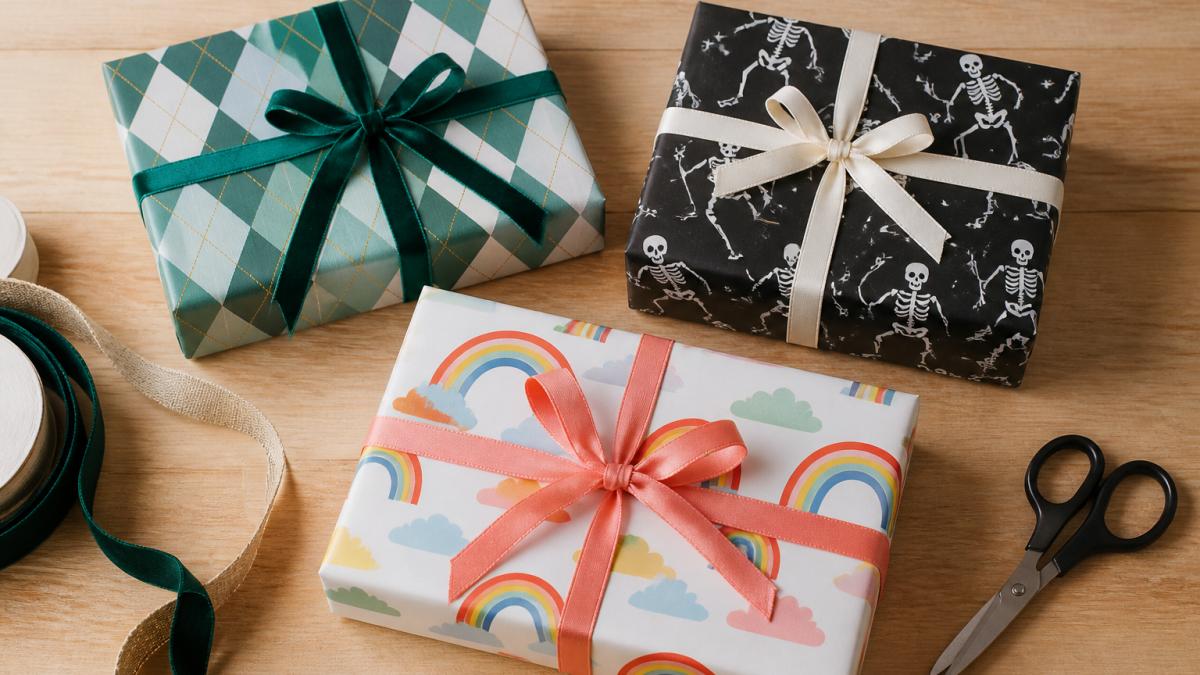
What makes a design feel modern
Three qualities separate modern designs from dated ones: a limited palette (two or three colours used confidently beats a busy multicolour print), a repeating motif with real drawing behind it rather than stock clip-art, and negative space that lets the eye rest.
A green, white, and dark-green diamond pattern shows geometry done well: texture from a distance, precision up close. A monochrome hand-drawn skeleton motif works the opposite way, quieter, more graphic, unmistakably deliberate.
Designs for niche occasions and themed parties
Niche occasions are where generic retailers fail: an engagement party, a milestone birthday, and a housewarming in one month need three visual languages a supermarket aisle cannot supply.
Specialist catalogues can. Look for themed ranges covering Day of the Dead, Pride events, Halloween parties, and seasonal autumn gatherings, each with a distinct palette rather than a recoloured template.

Designer Wrapping Paper: What You Get for the Higher Price
Designer wrapping paper costs more because of paper stock, print quality, and design licensing, not the label. Whether the premium is worth it depends on how much you care about the finished presentation.
Paper weight and print quality compared
The clearest difference is weight. Our rolls print on 90gsm fine art paper, which holds a crease and resists tearing at the corners.
Print quality matters just as much. High-definition, one-sided printing keeps colors rich and lines crisp.
| Paper type | Typical weight | Folds cleanly? | Best for |
|---|---|---|---|
| Mass-market roll | Light, unstated | Often tears at corners | High-volume filler gifts |
| Mid-range multipack | Moderate | Usually | Everyday birthdays |
| Designer fine art roll | 90gsm stated | Yes, holds a crease | Milestones, statement gifts |
Cost per wrapped gift: premium vs. mass-market
Cost per gift is the honest comparison, not cost per roll: a larger, pricier roll can work out cheaper per present if it is wide enough to wrap without patching.
The bigger variable is waste. Thin paper tears, so you re-cut; thick paper folds once and stays. Wrapping a dozen gifts, that difference narrows the price gap considerably.
Eco-Friendly Gift Wrap: Recycled Papers and Reusable Alternatives
Eco-friendly gift wrap is not one category. It splits into four options that behave differently at the wrapping table and the bin: recycled, recyclable, compostable, and reusable. Most guides collapse these into one "green" label, but the right choice depends on whether the recipient will unwrap and discard, or unwrap and keep.
Recycled vs. recyclable vs. compostable: what the words actually mean
These terms describe different stages of a paper's life, and a sheet can be one, two, or all three.
- Recycled describes the fibre source: made from post-consumer or post-industrial waste rather than virgin pulp. Recycled paper can still be glossy, printed, and laminated, which affects whether it can be recycled again.
- Recyclable describes what happens after use. Plain, uncoated paper with water-based inks is widely accepted in kerbside paper recycling. Foil stamping, glitter, metallic coatings, and heavy plastic lamination usually make a sheet non-recyclable in practice, even if the base paper is technically recyclable.
- Compostable describes breakdown in a composting environment. Uncoated paper and paper with compostable inks will break down in home or industrial composting. Compostable does not automatically mean recyclable, and recyclable does not automatically mean compostable.
The practical test: if paper is described as recycled but has a foil or glitter finish, treat it as neither easily recyclable nor compostable. If it is uncoated with water-based inks, it is usually both.
Reusable wrap: fabric, furoshiki, bags, and tins
Reusable wrap wins on total waste over time, and is strongest when the same people exchange gifts year after year.
Halloween Purple Spiderwebs Wrapping Paper | Holiday Gift Wrapping Paper Roll →
- Fabric wrap and furoshiki. A square of cotton, linen, or a cotton-blend cloth folds around a box and ties without tape. Furoshiki is the Japanese folding technique that turns one square into a bag, a bottle wrap, or a handled parcel. The wrap becomes part of the gift if the recipient keeps it.
- Gift bags. Sturdy paper or fabric bags with handles are the fastest reusable option. They survive several reuses if stored flat, and they suit awkward shapes that are hard to wrap in paper.
- Tins and boxes. Decorative tins and rigid boxes are the most durable reusable format. They cost more upfront, but a tin used five times beats five sheets of disposable paper on both waste and cost per use.
A common pattern: keep a small stash of reusable wraps in one size range for a household or close circle, and use paper for gifts that leave the home.
How to reduce waste without giving up the unwrapping moment
Many recipients still value tearing paper off a gift, so the goal is not to eliminate paper but to reduce the waste around it.
- Choose uncoated, unfoiled paper so it can actually be recycled.
- Match the sheet to the gift size so you are not cutting away half a roll.
- Reuse paper that comes off gifts carefully opened, and keep a folder for large intact sheets.
A simple decision rule
Use reusable wrap for gifts that stay within a household or close circle, where the wrap comes back to you. Use recycled or recyclable paper for gifts that leave your home. Use compostable paper only if you or the recipient have access to composting. If unsure, uncoated recycled paper with water-based inks is the safest default: it wraps well, photographs well, and goes in most paper recycling.
Shopping by Recipient, Occasion, and Aesthetic
Shopping by recipient beats shopping by category: the paper that suits a colleague's leaving gift will look wrong on a teenager's birthday present.
Start with the recipient's taste, narrow by occasion, then pick the finish.
Finish is the last decision and the easiest to get wrong. Glossy makes colors pop and photographs well; matte reads softer and more expensive and hides fingerprints on dark backgrounds.
Individual Sheets vs. Rolls vs. Multipacks: Sizing and Value
Individual sheets suit one-off gifts, rolls suit varied shapes, and multipacks suit volume. Choosing wrong is the most common way people overspend on wrapping.
Long rolls cover bottles, tall boxes, and awkward shapes without patching. Our rolls come in 30×36, 30×72, and 30×180 inch lengths, so one roll handles a small trinket or a large statement parcel.
- Individual sheets: best for one specific gift where the design matters most
- Short rolls: best for small boxes, books, and trinkets
- Long rolls: best for bottles, posters, and tall parcels
Shipping, Availability, and Delivery Timing
Delivery timing is the part of buying unique gift wrap most guides skip, and it decides whether the paper arrives before the event. The variables are predictable: production model, dispatch window, transit time, and seasonal stock pressure. Planning for these logistical delays ensures that your presentation remains as thoughtful as the unique gift ideas you have selected for your recipients.
Ready-to-ship vs. made-to-order: the real lead-time difference
The listing language tells you almost everything.
- Ready to ship means the design is already printed and held in stock. Dispatch usually happens within one to two business days, and the remaining variable is transit.
- Made to order means production starts after payment. Small-batch printmakers often work this way, and lead times commonly run from several days to a few weeks depending on the queue and the printing method.
- Pre-order means the design is not printed yet at all. Pre-orders are the riskiest option for a date-specific gift because the ship date can slip.
If a design matters and the date is fixed, ready-to-ship is safer. If you have flexibility and want a specific small-batch design, made-to-order is worth the wait.
How to estimate transit and order date
Work backwards from the event, not forwards from the order.
- Pick the date you need the paper in hand, not the date of the event. Wrapping usually happens a day or two before.
- Subtract the transit estimate. Domestic standard shipping is typically a few business days; international shipping is usually measured in weeks, not days.
- Subtract the dispatch window. Ready-to-ship is one to two business days; made-to-order is the seller's stated production time.
- Add a buffer for seasonal delays. Carrier networks slow down around major holidays, and a one-day buffer is not enough in peak season.
Buyers commonly underestimate international transit and overestimate how fast a small seller can produce. If either is uncertain, order earlier than feels necessary.
Seasonal stock and restock risk
Availability shifts fast around seasonal peaks. Halloween, Christmas, and Valentine's designs sell through first because demand is concentrated in a short window, and limited runs are often not restocked.
The practical implication: if a seasonal design matters, buy it when you see it rather than waiting for a sale, a discount on a sold-out design is worth nothing.
Shipping cost and availability considerations
Shipping cost scales with weight and distance, which matters more for wrapping paper because rolls are bulky and light. A few practical points:
- Rolls vs. sheets. Long rolls are more expensive to ship than flat sheets or multipacks because of length and dimensional weight. If shipping cost is a concern, sheets and short rolls are usually cheaper to send.
- International availability. Not every seller ships internationally, and those that do may exclude certain regions or apply customs duties on arrival. Check the shipping policy before assuming a design is available to you.
- Combining orders. If you need several designs, ordering them together usually costs less in shipping than placing separate orders, and it reduces the chance of one item arriving late.
A quick timing checklist
- Confirm the listing says ready to ship, made to order, or pre-order.
- Note the dispatch window and the transit estimate separately.
- Add a buffer for peak-season carrier delays.
Conclusion: How to Choose Your Unique Gift Wrap
Choosing unique gift wrap comes down to three decisions: the channel, the paper weight, and the finish. Get those right and the design almost picks itself.
Holiday Wrapper stocks over 1000 designs ready to ship, printed on 90gsm fine art paper with a choice of glossy or matte finish and three roll lengths per design, covering niche occasions, seasonal celebrations, and everyday milestones without compromising paper quality.
Browse the full range at Holiday Wrapper and wrap the next gift the way it deserves.
Frequently Asked Questions
Where can I buy unique wrapping paper online?
You can find unique gift wrap through online retailers that specialize in distinctive designs, independent printmakers who sell direct, and larger marketplaces that carry a mix of sellers. Specialist shops tend to offer the widest range of modern and designer patterns, often with ready-to-ship inventory. Holiday Wrapper, for example, stocks over 1000 designs, including geometric, hand-drawn, and seasonal options, with rolls starting at $15.99.
What makes wrapping paper high quality?
Paper weight is the main factor. Most mass-market rolls use thin paper that tears easily, while premium options use heavier stock that holds a crease without ripping. Look for paper described by its gsm (grams per square meter). Holiday Wrapper's rolls use 90 gsm fine art paper, which folds cleanly around boxes, bottles, and odd shapes. Print quality matters too: high-definition printing keeps colors sharp and patterns aligned, so the paper looks as good in person as it does online.
Is premium wrapping paper worth the price?
It depends on how you wrap and what the gift is for. Premium paper costs more per roll, but it resists tearing, so you use less per gift and waste fewer sheets. If you are wrapping a milestone birthday, a wedding gift, or a corporate recognition present, the finished look justifies the cost. For casual wrapping or large volumes of small items, a mid-range option may be enough. Holiday Wrapper's rolls start at $15.99 and come in three lengths, so you can match the size to your wrapping needs.
How much wrapping paper do I need for a gift?
A rough rule: measure the gift's longest side plus its depth, then double that for the length of paper you need. For a standard shirt box, a 30 by 36 inch sheet is usually enough. For bottles or long, narrow items, a 30 by 72 inch roll gives you more room to work without patching. Holiday Wrapper offers three sizes: 30x36, 30x72, and 30x180 inches, so you can pick the length that fits the gifts you wrap most often.
0 comments