

Table of Contents
- What You'll Need to Wrap a Box
- How to Measure Wrapping Paper for a Box
- How to Wrap a Box with Crisp Corners
- How to Wrap a Large Box
- How to Wrap a Box with Ribbon
- Troubleshooting Common Wrapping Problems
- Alternative Materials and Low-Waste Wrapping
- Frequently Asked Questions
Last Updated: October 7, 2026
What You'll Need to Wrap a Box
Wrapping a gift starts with gathering the right supplies. Quality materials make the job easier and the result better.
Here's what you'll need:
- Wrapping paper, Choose paper that's sturdy enough to fold without tearing. Lightweight paper tears easily when you crease it. We recommend using premium options like Holiday Wrapper's fine art paper rolls, which are printed on 90 gsm stock and hold creases cleanly.
- Sharp scissors, Dull scissors crumple paper instead of cutting it. A clean cut matters.
- A ruler or measuring tape, This helps you cut the right amount of paper without waste.
- Clear tape, Regular clear tape works best. Avoid colored tape unless you want it visible.
- A flat surface, A table or floor gives you room to work and keeps edges straight.
The quality of your wrapping paper affects everything. Thin paper tears when folded and looks flimsy; heavier paper holds its shape, creases stay sharp, and the finished gift looks intentional.

If you're wrapping multiple gifts, gather all supplies first to avoid hunting for scissors mid-project.
How to Measure Wrapping Paper for a Box
Measuring correctly is the biggest time-saver. Most people cut too much paper, waste it, then run short.
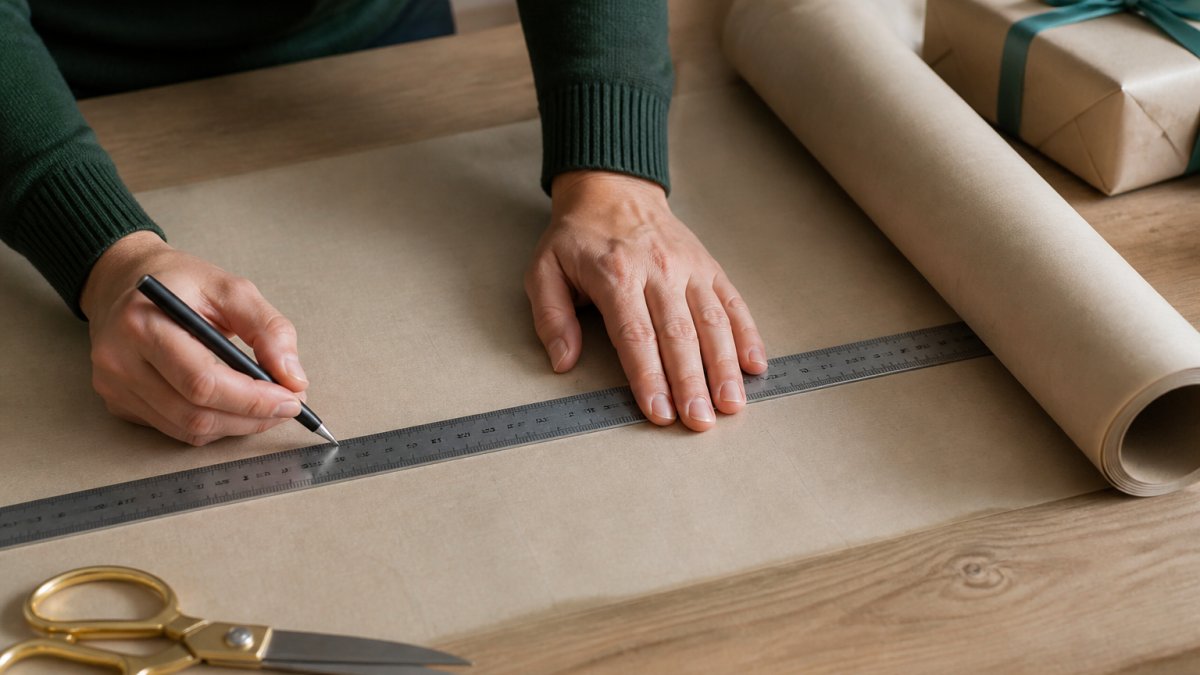
Here's the formula:
For the length (the wrap-around measurement):
- Measure around the widest part of the box
- Add 2 inches for overlap
- This is how long your paper needs to be
For the width (the top-to-bottom measurement):
- Measure from one end of the box to the other
- Add 1 inch on each end for a small overlap
- This is how wide your paper needs to be
Example: A standard 8×6×4 box needs about 15 inches around and 6 inches tall.
A common mistake is measuring only one dimension.
Mark measurements with a pencil, light marks won't show on the finished gift, and cut straight lines using the ruler as a guide.
How to Wrap a Box with Crisp Corners
Crisp corners separate a handmade gift from a store-wrapped one. Once you learn the technique, every box looks professional.
Placing and Securing the First Edge
Place your box in the center of the paper, seam-side down, so the seam runs along the bottom, hidden from view.
Fold one long edge up and over the box, reaching the opposite side without overlapping too much, and tape it down with a single piece of tape along the center.
Fold the other long edge over, overlapping the first slightly, and tape it down. The top and bottom are now covered.
Use minimal tape, one piece per edge. Multiple pieces create bulk and look messy.
Folding and Creasing the Corners
This is where the crisp corners happen. At one end of the box, you'll see two flaps of paper sticking up.
Fold the side flaps toward the center, meeting or overlapping slightly, and crease them too.
Fold the bottom flap up and over, tape it down, and the corner should look like a sharp, clean triangle.
Repeat on the other end of the box.
Pro tip: crease as you go. Each fold should be sharp and intentional.
How to Wrap a Large Box
Large boxes break the standard method because one sheet often can't span the full length, and heavy folds sag or tear. Don't wrap in halves, that leaves a visible seam. Instead, adapt the measurement and fold sequence.
Measuring for a Large Box
Use the same wrap-around formula, but for boxes wider than 12 inches add 3 inches of overlap instead of 2, giving you room to crease without tearing the sheet.
If the box is longer than your paper's width, you have two workable options:
Argyle Design 049 Wrapping Paper - Holiday Gift Wrapping Paper Roll →
- Rotate the box. Place it so the longest dimension runs along the length of the paper roll rather than across it. Most rolls are 30 inches wide, which covers a surprising number of "large" boxes once rotated.
- Use a two-sheet seam on the bottom. Cut two sheets that each cover half the box plus 2 inches of overlap. Tape them together on the bottom face of the box, then wrap as normal. The seam stays hidden and the top surface stays clean.
Wrapping an Oversized Box Step by Step
- Place the box seam-side down on the paper. For very large boxes, work on the floor, a table edge will fight you.
- Pull one long edge of paper up and over the top. Tape it at the center of the bottom face, not the top.
- Pull the opposite edge over and overlap it by 2-3 inches. Tape along the full seam, not just the center. Large sheets shift more than small ones.
- Stand the box on one end. Fold the top flap down and crease it against the box edge with the side of your hand.
- Fold the two side flaps inward, trimming any excess with scissors before you crease. On a large box, untrimmed side flaps create a bulge you can't fold flat.
- Fold the bottom flap up, crease, and tape. Repeat on the other end.
Shallow, Round, and Irregular Boxes
- Shallow boxes (under 2 inches deep): Reduce your overlap to 1 inch. Too much paper on a shallow box creates a thick pad on the bottom that won't sit flat.
- Round boxes: Treat the lid and base as separate wraps. Cut a square of paper large enough to cover the top plus 2 inches on every side, center the lid, and pleat the paper around the curve rather than folding corners. Tape each pleat as you go.
- Irregular shapes (triangular, hexagonal, novelty): Wrap the box in tissue first to smooth the silhouette, then wrap the tissue-covered shape as if it were rectangular. The paper follows the softened outline instead of fighting the corners.
When to Skip Paper Entirely
For very large or awkward boxes, a gift bag, a reusable fabric wrap, or a lidded storage bin with a ribbon often looks better than paper that wrinkles under its own weight. There's no rule that says a large gift has to be paper-wrapped, a clean presentation matters more than the material.
How to Wrap a Box with Ribbon
Ribbon adds color, texture, and polish to a wrapped gift.
Wrap your box first using the crisp corner method, then let the tape set.
Now measure your ribbon. Wrap it around the box lengthwise, then widthwise.
Tie a simple knot at the top, then a bow, adjusting the loops so they're even.
For a professional look, use ribbon that complements your paper. Holiday Wrapper's designs pair well with solid-colored ribbons in coordinating tones.

A silk scarf works as ribbon too, creating an elegant, unusual look, tie it the same way.
Troubleshooting Common Wrapping Problems
Paper tears while you're wrapping: Stop and use tape to secure the tear. Tears happen with thin paper. Thicker paper like Holiday Wrapper's fine art stock resists tearing better.
Corners look lumpy or uneven: This usually means you folded too much paper into the corner.
Seams are visible on top of the box: Your seam should always run along the bottom.
You have too much paper left over: You measured too generously.
Tape shows and looks messy: Use less tape. One piece per seam is enough.
The paper won't stay folded: Your paper might be too thin. Heavier paper holds folds better. Also, crease harder.
Alternative Materials and Low-Waste Wrapping
Every material below wraps a box, but each behaves differently, fabric doesn't crease like paper, newspaper tears along the grain, and kraft paper needs sharper folds. Here's how to adapt the method for each.
Kraft Paper
Kraft paper is thicker and more fibrous than decorative paper, making it forgiving on corners but harder to crease sharply. Press each fold flat with the back of a spoon or a bone folder. Its neutral surface takes ribbon, twine, stamps, and hand-drawn designs well, and plain kraft typically costs less per square foot than printed paper and can be recycled curbside in most municipalities.
Fabric and Furoshiki
Fabric wrapping, often called furoshiki, a Japanese tradition, uses a square cloth instead of paper. The technique is different from paper wrapping: you place the box diagonally in the center of the cloth, bring two opposite corners up over the top, tie them once, then bring the remaining two corners up and tie them again. The knot holds the wrap in place, so no tape is needed.
Newspaper and Magazine Pages
Newspaper tears easily along its grain, so cut with scissors rather than ripping by hand. The ink can smudge on light-colored ribbon, so pair it with twine or paper tape instead. For a cleaner look, use the financial or classified pages, the dense text reads as a pattern from a distance. Magazine pages work for small boxes but are glossy and resist tape; use a small piece of double-sided tape at each seam.
Brown Paper Bags
Cut the bag open along one side and the bottom, then flatten it. The inside face is usually unprinted and gives you a clean, matte surface. Bags are sturdier than tissue but thinner than kraft, so they crease well but tear if you pull them tight. Use them for small-to-medium boxes and finish with twine and a sprig of greenery or a paper tag.
Reusable Bags and Boxes
A fabric drawstring bag or a lidded box can serve as the wrapping itself. Slip the gift inside, tie the drawstring or add a ribbon, and skip paper entirely. This works especially well for gifts that will be stored or transported, since the wrapping doubles as packaging.
Low-Tape and No-Tape Techniques
Tape is the hardest part of wrapping to recycle, so reducing it matters. Three approaches work:
- Japanese-style folds: Tuck the final flap under the previous fold instead of taping it. This requires slightly more overlap (about 3 inches) but holds without adhesive.
- Twine or ribbon as the closure: Wrap the box, then tie twine around both axes. The twine holds the paper in place so you only need tape at the initial seam.
- Washi tape: Paper-based washi tape tears cleanly and can be recycled with the paper in many curbside programs, unlike plastic clear tape.
For gifts you want to feel special from the moment they're opened, quality wrapping paper makes a difference. Holiday Wrapper offers over 1000 designs in premium fine art paper. The 90 gsm stock holds creases without tearing, and the designs range from geometric patterns to seasonal themes. Whether you choose Argyle Design 049 with its bright geometric diamonds or Argyle Design 025 with its sleek black-and-white pattern, premium paper elevates the entire wrapping experience.
Frequently Asked Questions
How much wrapping paper do you need to wrap a box?
A standard rule: the paper width should be at least 2.5 times the box width, and the length should wrap around the box height plus half the box depth on each end. For a 10×6×4 inch box, you'd need roughly 25-30 inches of paper width and 15-18 inches in length. Measure your specific box dimensions before cutting to avoid waste and ensure you have enough coverage for crisp corners.
What's the best wrapping paper to use for a neat finish?
Choose heavyweight, fine art paper stock (90 gsm or higher) that holds creases well and resists tearing. Premium wrapping paper like Holiday Wrapper's Argyle designs are printed on durable fine art paper available in glossy or matte finishes, making them ideal for achieving clean, professional-looking folds and sharp corners without the paper ripping during handling.
How do you wrap a box without tape showing?
Place seams on the back or bottom of the box where they won't be visible. Use small pieces of tape rather than large strips, and position them along edges or under folds. Practice folding so that overlaps meet cleanly, aim for the paper to meet exactly or overlap slightly on the back. Double-sided tape can also hide seams, though it requires more precision to apply.
Can you wrap a box without wrapping paper?
Yes. Fabric like silk scarves, tea towels, or linen can wrap a box beautifully and be reused or repurposed afterward. Brown kraft paper, newspaper, or brown paper bags offer an eco-friendly, low-waste alternative. Even plain kraft paper can look intentional when paired with ribbon, twine, or natural decorative elements, creating a handmade aesthetic that feels thoughtful.
0 comments