

Table of Contents
- Best Wrapping Paper for Shipping Gifts: Quick Comparison
- What Makes Wrapping Paper Strong Enough to Ship
- Top Picks: Holiday Wrapper Rolls Built for Shipping
- How to Wrap a Box So It Survives the Mail
- Kraft Paper for Gift Wrapping: When to Choose It
- Bulk Gift Wrapping Paper: Cost Per Gift and Value
- Shipping Gifts Safely: Carrier Rules and Parcel Prep
- Frequently Asked Questions
Last Updated: October 16, 2026
Best Wrapping Paper for Shipping Gifts: Quick Comparison
The best wrapping paper for shipping gifts needs two qualities decorative paper usually lacks: enough weight to survive handling and enough flexibility to fold around a box without splitting. At Holiday Wrapper, we print every roll on 90 gsm fine art paper for exactly that reason.
Here is the short version before the detail.
| Roll | Design | Sizes | Finish | Price |
|---|---|---|---|---|
| Christmas Ho Ho Ho Trees | Blue and green trees, mittens, snowflakes | 30x36, 30x72, 30x180 in | Glossy or matte | $15.99 |
| Christmas Ugly Candles | Evergreen motifs, gifts, bows | 30x36, 30x72, 30x180 in | Glossy or matte | $15.99 |
| Day of the Dead Sugar Skulls | Turquoise skulls on grey | 30x36, 30x72, 30x180 in | Glossy or matte | $15.99 |
| Christmas Green Candy Canes | Candy canes, stars, snowflakes | 30x36, 30x72, 30x180 in | Glossy or matte | $15.99 |
The 30x180 inch roll is the one most people should buy for a shipping-heavy season: it covers multiple parcels from a single continuous sheet.

What Makes Wrapping Paper Strong Enough to Ship
Wrapping paper for shipping is decorative paper heavy enough to resist tearing during folding, taping, and transit. Standard gift wrap sits around 60 to 70 gsm; 90 gsm paper feels stiffer and holds a crease instead of springing back.
That difference shows up at the worst moment: thin paper splits along a folded corner while you pull tape tight, and the tear stays invisible until the recipient opens the parcel.
Three properties decide whether a roll is up to the job:
- Weight (GSM): grams per square metre. Higher means denser fibre and more resistance to punctures.
- Tear resistance: how much force the sheet absorbs before it rips from an edge nick.
- Fold memory: whether the paper stays where you crease it or unfolds itself under tape.
Paper Weight, Tear Resistance, and GSM Explained
GSM is the most useful number on a wrapping paper listing: it tells you how much a one-square-metre sheet weighs and correlates closely with how the paper behaves under tension. A common mistake is judging paper by feel through plastic wrap in a store, thin stock collapses instantly, while 90 gsm stock pushes back.
Top Picks: Holiday Wrapper Rolls Built for Shipping
Every roll below shares the same foundation: 90 gsm fine art paper, one-sided high-definition print, glossy or matte finish, and three lengths. What separates them is pattern, coverage, and how well each suits a specific gifting calendar.
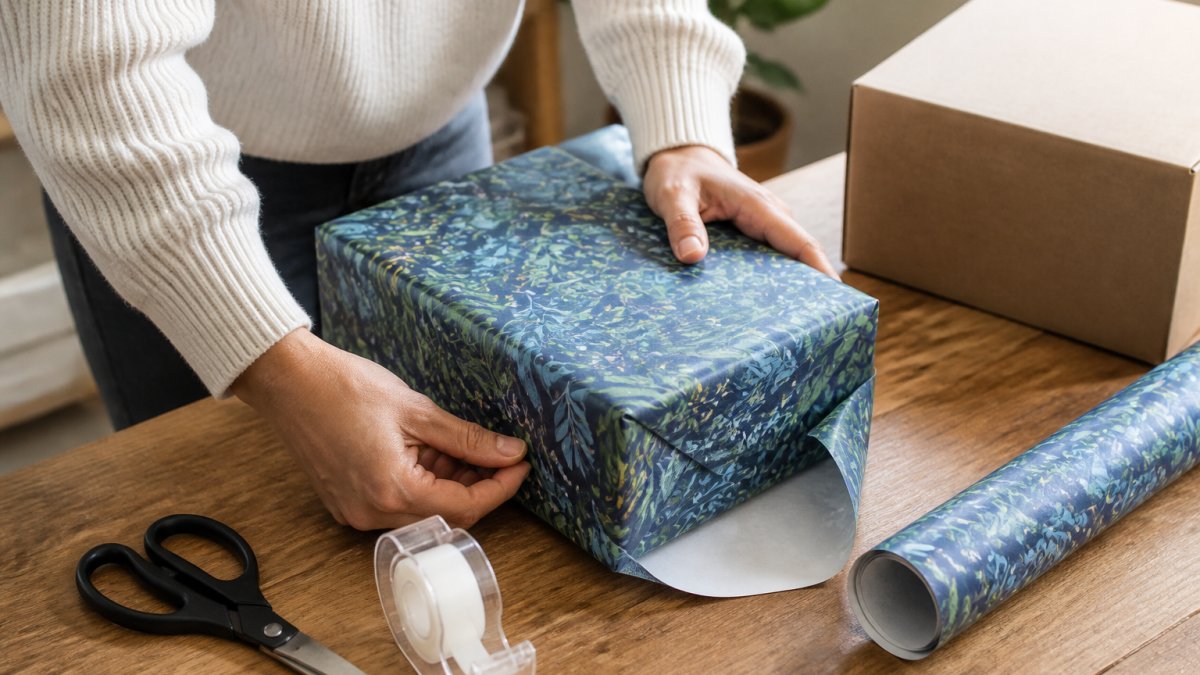
Christmas Ho Ho Ho Trees: The Blue and Green Standout
The cool blue and green palette makes this roll a popular choice for corporate gifting. Hand-drawn trees, mittens, snowflakes, and tiny gift icons repeat in a pattern that reads calm rather than loud.
For shipping, the appeal is the 30x180 inch option: one continuous length wraps several boxed gifts without matching seams, and the 90 gsm stock takes packing tape without wrinkling.
Christmas Ugly Candles: Long-Roll Coverage for Multiple Parcels
Deep evergreen background with rows of stylized gifts, socks, bows, and snowflakes in seasonal reds and greens. This is the roll we recommend when wrapping a dozen parcels in one sitting: the evenly spaced repeating motif lets you cut at almost any point and still land on a clean section of pattern.
Day of the Dead Sugar Skulls: Year-Round Versatility
Turquoise skulls with dot and floral accents on soft neutral grey work for birthday gifts, themed parties, or to add personality to seasonal exchanges.
The 90 gsm stock folds cleanly around awkward shapes.
How to Wrap a Box So It Survives the Mail
Wrapping for shipping follows five steps. The goal: a tight, sealed package with no loose flaps to catch on sorting equipment.
- Wrap the gift in tissue first. This gives the decorative paper a smooth surface and absorbs small impacts.
- Cut paper with 5 cm of overlap on every side. Under-measuring is the most common reason corners tear.
- Fold and tape the long edges first, then the short ends. Crease each fold firmly with your thumb.
- Tape every seam twice, once on the paper and once across the fold. Tape is cheaper than a rewrap.
- Place the wrapped gift inside a rigid shipping box with padding on all six sides before sealing.
Kraft Paper for Gift Wrapping: When to Choose It
Kraft paper for gift wrapping wins on two counts: it takes ink and stamps beautifully, and its natural brown tone suits minimalist presentation.
Where kraft falls short is visual variety, a plain brown roll looks the same in December as in June, so it carries less occasion-specific meaning than a printed design. Treat kraft as a base layer rather than a replacement: use a plain sheet underneath and a printed 90 gsm design on top, or wrap in kraft and finish with a printed band cut from a patterned roll.
Bulk Gift Wrapping Paper: Cost Per Gift and Value
Bulk gift wrapping paper only saves money if you calculate cost per shipped parcel rather than cost per roll. A long roll at a higher price can beat a short roll at a lower price once you divide by parcels covered, but only if you also count the materials that make a wrapped gift shippable.
The mistake most buyers make is comparing roll prices side by side. A $15.99 long roll and a $6.99 short roll look like a $9 gap; divide by usable coverage and the gap often flips.
Step 1: Estimate usable paper per gift
Start with box dimensions, not gift category. A practical rule: paper length = box length + box width + 2 × box height + 5 cm overlap on each side.
- Small box (up to 20 cm): roughly 0.5 m of paper per gift
- Medium box (20 to 40 cm): roughly 1 m per gift
- Large or awkward box: roughly 1.5 to 2 m per gift
Add 10 to 15 percent for miscuts, pattern matching, and the first wrap of a new roll. That waste is real and most cost comparisons ignore it.
Christmas Ho Ho Ho Trees Wrapping Paper | Holiday Gift Wrapping Paper Roll →
Step 2: Convert roll length to gift count
A 30x180 inch roll is 180 inches, or about 4.57 m, of usable length at 30 inches wide. At 1 m per medium gift, that is roughly four medium gifts per roll, not eight.
The "long roll is better value" claim needs a caveat: the long roll wins on cost per gift only when your boxes fit within the 30-inch width and you use the full length.
Step 3: Add the shipping materials, not just the paper
A wrapped gift is not a shippable parcel. The real cost per parcel includes:
- Wrapping paper: the per-gift figure above
- Tape: roughly one full wrap of packing tape per seam, plus two passes on the outer box
- Padding: bubble wrap, kraft void fill, or air pillows on all six sides
Paper is often the smallest line item. The value question is not price but "does this paper let me wrap fast and ship without a rewrap?" A cheap roll that tears at the corner costs you a second sheet, a second tape pass, and time.
Step 4: Compare cost per parcel, not cost per roll
Run the arithmetic before you buy:
- Short roll, low price: lower upfront cost, higher cost per gift if you run out mid-session and reorder
- Long roll, higher price: lower cost per gift above roughly eight medium parcels in one season
- Mixed designs: higher cost per gift because you carry inventory across patterns and may not use each roll fully
For corporate orders, buy the long roll in one design and keep the presentation consistent across every recipient. Uniform wrapping reads as intentional; a mix of leftover rolls reads as an afterthought. It also simplifies your cost-per-parcel math because you are not tracking multiple SKUs.
A note on bulk and wholesale purchasing
Bulk pricing usually kicks in at case quantities, not single rolls. Before you commit, confirm three things with the supplier: usable length per roll (not outer diameter), recycled content and coating if sustainability matters to your recipients, and whether the design is a seasonal print that will be discontinued.
Shipping Gifts Safely: Carrier Rules and Parcel Prep
Carrier rules on parcel preparation exist for a reason: loose wrapping, protruding ribbon, and soft-sided packaging cause most transit damage claims. But the rules are only half the story, the other half is how your wrapping paper behaves once the parcel leaves your hands.
What actually happens to a wrapped gift in transit
A parcel in a carrier network is not treated gently: it is sorted on belts, stacked under other parcels, and sometimes exposed to moisture. The forces that matter for wrapping paper are:
- Abrasion: the wrapped gift shifts inside the outer box and rubs against the box wall or padding. Thin paper scuffs and can wear through at corners.
- Compression: stacked parcels press down on the outer box. Without support on all six sides, the paper creases and can split along a fold.
- Moisture: rain, humidity, and condensation soften paper fibres. Uncoated paper absorbs moisture faster than coated stock.
Decorative wrapping paper is not a substitute for protective packaging. The paper is presentation; the outer box and padding are protection. A 90 gsm sheet resists handling better than 60 to 70 gsm, but no decorative paper survives direct contact with sorting equipment.
How to prepare a wrapped gift for shipping
- Wrap the gift in tissue first. This gives the decorative paper a smooth surface and absorbs small impacts.
- Cut paper with 5 cm of overlap on every side. Under-measuring is the most common reason corners tear.
- Fold and tape the long edges first, then the short ends. Crease each fold firmly with your thumb.
- Tape every seam twice, once on the paper and once across the fold. Tape is cheaper than a rewrap.
- Place the wrapped gift inside a rigid shipping box with padding on all six sides before sealing.
- Remove or flatten anything that protrudes. Ribbon bows, gift tags, and decorative toppers belong inside the outer box, not on it.
- Seal all outer box seams with packing tape, not masking tape or ribbon, running tape along every open edge and over the corners.
- Keep the address label flat against the box, not wrapped around a corner where it can peel.
Carrier rules you should confirm before dispatch
Carrier requirements vary by service and destination, so check current guidance directly rather than relying on a general rule. The basics most carriers share:
- The outer box must be rigid and undamaged, with no reused crush marks.
- All seams need packing tape, not masking tape or ribbon.
- Address labels must be flat against the box, not wrapped around a corner.
For current size limits, weight caps, and prohibited items, check the carrier's own guidance directly: Royal Mail packaging and parcel guidance and USPS shipping restrictions and packaging rules both publish their requirements in full.
Photograph the sealed parcel before dispatch: if a claim is ever needed, a dated image of a properly prepared box supports your case far better than a description.
A quick durability check before you commit
To know whether a roll is up to shipping, test it before wrapping a season's worth of parcels. Fold a small square over a box corner, press it flat, and run your thumb along the crease.
This is the test most gift-wrap guides skip, and it separates a roll that looks good in photos from one that arrives intact.
Frequently Asked Questions
What kind of paper is best for wrapping a gift that will be shipped?
Paper weight matters most. Look for 90 gsm or heavier, which resists tearing when folded around box corners. Holiday Wrapper rolls use 90 gsm fine art paper that holds creases without splitting. Pair heavier paper with a protective outer layer, such as bubble wrap or packing paper, inside the shipping box. Lighter tissue-style papers tear at corners under transit pressure.
Should I wrap a gift before putting it in a shipping box?
Yes, but protect the wrapped gift first. Place the wrapped item inside a plastic bag or wrap it in bubble wrap before it goes into the shipping box. This keeps tape, moisture, and box edges from damaging the decorative paper. Use the shipping box as the outer shell, not the gift presentation itself.
Is kraft paper a good choice for shipping gifts?
For decorative wrapping, 90 gsm fine art paper from Holiday Wrapper gives crisper folds and richer print detail.
How do you keep wrapping paper from tearing during shipping?
Two things prevent tearing: paper weight and outer protection. Choose 90 gsm paper, which resists corner tears better than thin alternatives. Then cushion the wrapped gift with bubble wrap or packing paper so it does not shift against the box walls. Fill empty space so the parcel cannot slide during transit. Secure all seams with quality tape.
What size wrapping paper roll do I need for a large gift?
Holiday Wrapper rolls come in 30x36, 30x72, and 30x180 inch sizes. For a large gift or multiple parcels, the 30x180 inch roll gives continuous coverage without patching seams. The 30x72 inch roll handles most standard box sizes. A 30x36 inch roll suits small tokens and accessories.
0 comments